
Why India's Snacks Taste Different From City to City
Share on Social Media
A Nation of a Thousand Kitchens
Ask someone from Indore, Bhopal, and Jaipur to describe "Indian snacks" and you'll get three completely different answers. That's the thing about Indian food that often gets flattened in translation — it isn't one cuisine wearing different outfits. It's dozens of distinct food cultures, each shaped by its own soil, spice trade, climate, and centuries of local habit.
Travel a few hundred kilometers in any direction and the chaat changes, the pickle changes, the after-dinner ritual changes. Here's why — and a taste of what makes a few of these food cities so unmistakably themselves.
Indore: The City That Seasons Everything
Indore doesn't really have a "signature dish" so much as a signature move: it seasons things aggressively, and it seasons them last. Walk through Sarafa Bazaar at night and you'll see it in action — a plate of poha, dahi vada, or bhutte ka kees, finished tableside with a spoonful of something dark, tangy, and faintly smoky.
That something is usually jeeravan masala, Indore's answer to a finishing salt. It's a dry spice blend built around roasted cumin, dried mango powder, and black salt, and its entire job is to show up at the very end of cooking and wake the dish up. Our Indori Jeeravan Masala is modeled on the street-cart version — spoon it over poha, sprinkle it into buttermilk, or dust it on roasted peanuts for an instant upgrade.
Bhopal: Tangy Comes First, Sweet Comes Second
A few hours away, Bhopal's snacking identity runs on a different axis entirely: tamarind. Where Indore chases smoky-tangy, Bhopal leans into pure, puckering sourness, usually rounded out with just enough jaggery to keep it from being a full assault on the senses.
This shows up most charmingly in the city's tamarind candies — small, hand-rolled laddus sold by street vendors that manage to be tangier than sweet, which is exactly the point. It's less a dessert than a digestive, meant to be popped after a heavy meal the way you might reach for a mint. Our Bhopal Imli Goli Laddu is our take on the street-vendor original.
Rajasthan: Heat as a Love Language
Then there's Rajasthan, where the desert climate and a historic scarcity of fresh vegetables pushed cooks toward one very effective preservation strategy: pickling everything, generously, in oil and chili.
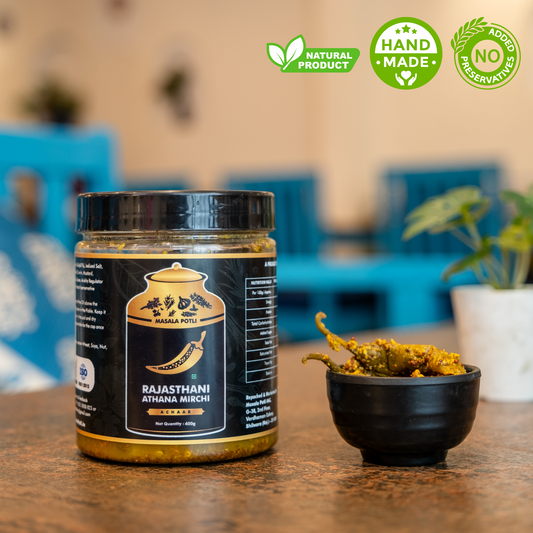
Rajasthani achar isn't a condiment on the side of the plate — it's often the main flavor driver of an otherwise simple meal of roti and dal. Whole green chillies packed with mustard seed and turmeric in our Athana Mirch Pickle, or carrots gone deep red with masala, aren't garnishes so much as co-stars. It's a style of cooking that treats "spicy" as an expression of hospitality, not an afterthought.
Gujarat: Where Sweet Sits at the Center of the Plate
Cross into Gujarat and the entire flavor logic flips again. Sweetness isn't reserved for dessert here — it runs straight through the savory course, most famously in chundo. Our Aam Chunda is a slow-cooked sweet mango pickle that shows up alongside dal-rice, in sandwiches, and stirred into yogurt.
It's a reminder that "sweet and savory" isn't a fusion trend in India — in plenty of regional kitchens, it's just how the meal has always been built.
Why This Matters When You're Cooking at Home
Understanding these regional identities changes how you use spice blends and condiments at home. A few ways to lean into it:
- Taste before you commit. Indori jeeravan, Rajasthani achar, and Gujarati chundo aren't interchangeable — try a small spoon on its own before deciding how much goes on the plate.
- Finish, don't just cook with it. Many of these regional flavor bombs — jeeravan especially — are built to be added at the very end, not simmered in.
- Pair contrasts on purpose. A sweet Gujarati chundo alongside a fiery Rajasthani pickle on the same thali is a genuinely great combination, not a mistake.
- Let one jar do double duty. A good regional pickle or masala rarely has just one use — the same jeeravan that seasons poha also works on fries, eggs, and roasted vegetables.
India's food map is really a map of thousands of small decisions — what grew nearby, what needed preserving, what the local palate craved after a heavy meal. The next time a snack or pickle tastes unfamiliar, it's worth asking not just "what is this" but "where is this from" — the answer usually explains everything.