
How Hing Is Made: The Story Behind India's Boldest Spice
Share on Social Media
The Pinch That Changes Everything
Open almost any Indian kitchen's masala dabba and you'll find a tiny tin tucked in one corner, holding something that looks like pale yellow dust but smells strong enough to clear a room. That's hing — asafoetida — and despite needing only the smallest pinch, it's one of the most quietly powerful ingredients in Indian cooking. It turns raw onion-garlic smell into rounded savouriness, makes dals taste like they've simmered for hours, and helps digestion along the way. But very few of us have actually seen how it gets from a wild plant in Afghanistan or Kashmir to that little tin on the shelf.
From a Desert Root to a Resin
Hing isn't a seed, bark, or leaf like most spices — it's dried plant resin, and the harvesting process is almost unbelievably patient. The Ferula plant grows for several years in cold, arid regions before it's ready. Each spring, harvesters expose the thick taproot and slice off the top, then cover the wound with leaves and soil to form a small dome over it.
A few days later, they return, scrape off a thin layer of the hardened resin that has oozed out, and cut a fresh surface to start the process again. This is repeated on the same root every few days for about three months, until the plant simply stops producing sap. One root, tended patiently across an entire season, yields only a modest amount of raw resin — which is part of why real hing has always been treasured rather than used carelessly.
Turning Resin Into the Powder You Know
The raw resin that's collected is sticky, intensely pungent, and far too strong to use as-is — a piece the size of a grain of rice can flavour an entire pot of dal. So once it's cleaned and dried, it's carefully ground and blended with a small amount of edible starch, usually rice flour or wheat flour, to bring it down to a usable strength and turn it into the fine, pourable powder most of us grew up with.
This is also why reading the label matters. The ratio of actual resin to starch determines how potent (and how authentic) a hing powder really is — which is exactly why we source ours carefully rather than just buying whatever's cheapest on the market.
Why Just a Pinch Does So Much
A few reasons hing has held its place in Indian kitchens for centuries:
- It builds savoury depth instantly — that first sizzle in hot ghee or oil is often the difference between a flat dal and one that tastes properly cooked.
- It's a classic onion-garlic substitute — a pinch bloomed in the tadka gives Jain and satvik cooking that same rounded, savoury base.
- It's traditionally used as a digestive aid — which is exactly why you'll find it doing double duty beyond the tadka pan, in after-meal remedies too.
- A little goes an extraordinarily long way — most recipes call for a pinch, not a spoon, so a small tin lasts a household for months.
Beyond the Tadka Pan
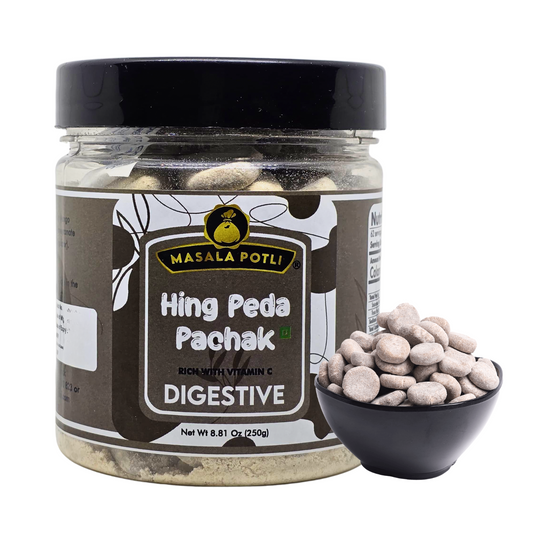
Most of us only ever meet hing sizzling in hot oil at the start of a dal or sabzi, but its digestive reputation runs much deeper in Indian food culture — it shows up in Ayurvedic home remedies and after-meal churans as often as it does in cooking. If you've enjoyed that warm, slightly tangy digestive candy that shows up after a heavy thali, there's a good chance hing was the ingredient doing the quiet work. Our Hing Peda Churan is built around exactly that tradition — a small, sweet-tangy bite for after meals that leans on the same root ingredient this whole post is about.
A Small Tin, A Big Legacy
Next time you flick open that little tin before starting your tadka, it's worth pausing for a second on what actually got you there — a taproot tended for years, tapped by hand every few days for months, and reduced down to the smallest possible pinch of pure flavour. Few spices ask for that much patience to make, and even fewer reward it so generously. That's hing: unglamorous to look at, unforgettable in the pot.