
How Are Traditional Indian Pickles Made? The Age-Old Art of Achar-Making
Share on Social Media
Long before refrigerators existed, Indian households needed a way to keep vegetables and fruit edible for months at a time — and pickling was the answer. The method hasn't changed much in centuries, and that's mostly the point: it works.
Step 1: Choosing and prepping the produce
It starts with the raw ingredient — raw mango, green chilli, carrot, lemon, garlic, whatever the pickle calls for — picked at a specific stage of ripeness. Raw mango for keri ka achar, for example, needs to be firm and sour, not ripe. The produce is washed, cut, and in many recipes, sun-dried for a day or more to draw out excess moisture. Less moisture means less chance of spoilage later.
Step 2: The spice blend
Every region has its own combination, which is why a Gujarati achaar and a Rajasthani achaar taste nothing alike even when made from the same vegetable. Common building blocks include mustard seeds (whole or coarsely ground), fenugreek, turmeric, red chilli powder, and asafoetida. Some recipes roast the spices first to deepen the flavour; others use them raw.
Step 3: The oil cure
This is the step that actually preserves the pickle. Mustard oil is heated until it reaches a specific point (traditionally until it stops "smoking" and settles), then cooled slightly and poured over the spiced produce. The oil does two jobs: it carries the flavour of the spices into the vegetable, and it forms a seal that keeps air and bacteria out. This is why proper achaar doesn't need refrigeration once it's cured — the oil is doing the work a fridge would otherwise do.
Step 4: Maturing in the sun
A freshly made pickle isn't at its best on day one. Traditional pickle-making leaves the jar out in direct sunlight for several days to weeks, depending on the recipe — this slowly develops the deeper, rounder flavour that distinguishes a properly matured achaar from a quick one. It's also why homemade pickle-making is seasonal in a lot of households, timed around when the sun is strong enough.
Step 5: Storage
Once matured, the pickle goes into an airtight jar — traditionally a ceramic or glass barni — and is topped up with a little extra oil if the level has dropped. As long as the produce stays submerged under oil, a well-made pickle keeps for months.
Why the traditional method still matters
Modern pickles can be made faster with vinegar or shortcuts, but they don't taste the same, and they don't always keep the same way either. The slow, oil-based method is more work, but it's also why a properly made achaar can sit in your pantry for months without artificial preservatives.
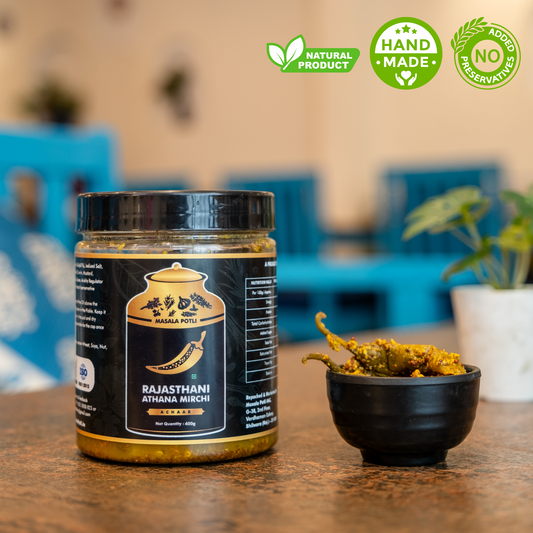
At Masala Potli, we still make our pickles this way — small batches, real mustard oil, sun-matured, no shortcuts. See how it tastes for yourself.